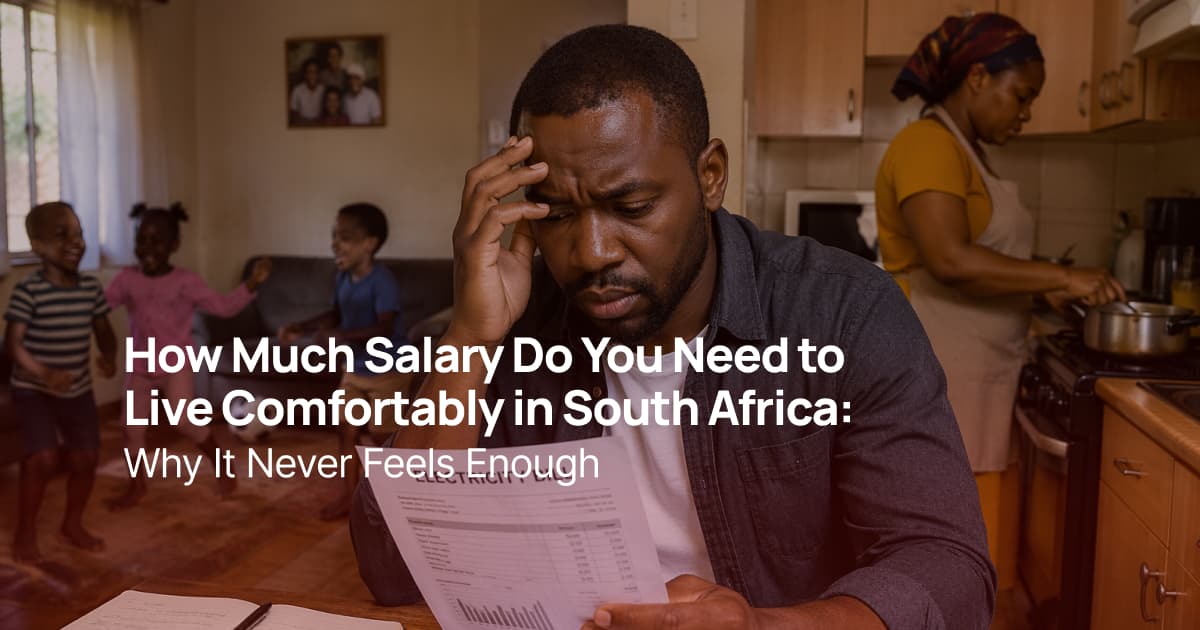
How Much Salary Do You Need to Live Comfortably in South Africa: Why It Never Feels Enough
Advertiser Disclosure: MoneyHello is an independent, advertising-supported comparison service. We may earn a referral fee if you click our links or use our matching tool to connect with a lender. This does not affect the content of our articles or the loan offers you receive.
April is hitting South African households hard. Electricity prices have surged by approximately 85% over the past five years (to January 2026), putting serious pressure on monthly budgets.
At the same time, petrol prices have spiked sharply in recent months, further increasing the cost of living for many South Africans.
The result? Even if your salary stays the same, your cost of living keeps rising.
And this is where the real problem begins.
You might be earning more than you did a few years ago, but it still doesn’t feel like enough. By the middle of the month, a large portion of your salary is already gone on essentials like rent, groceries, transport, and electricity.
So the question becomes unavoidable:
How much do you actually need to earn to live comfortably in South Africa today?
The answer isn’t simple, because “comfortable” means different things to different people. For example, the average salary in South Africa is R29,690, for somebody this will be enough for comfortable living, for others – a bare minimum. It depends on your lifestyle, location, financial responsibilities, and whether you’re supporting just yourself or a family.
But one thing is clear: For many South Africans, the gap between income and expenses is growing.
In this blog post, we’ll break down the real cost of living in South Africa in 2026.
What Does “Living Comfortably” Mean in South Africa?
“Living comfortably” doesn’t mean living a luxury lifestyle. It means having financial stability without constant stress.
In practical terms, it includes:
- Paying all your monthly expenses on time
- Affording basic needs like food, transport, and electricity
- Having some money left for savings or emergencies
- Not relying on credit for everyday expenses
In short: comfort = control over your finances
The Reality in South Africa (Backed by Data)
The challenge is that for many South Africans, this level of comfort is becoming harder to achieve.
- In some cases, consumers spend up to 70-80% of their income on debt repayments
- Around 70% of consumers report experiencing financial stress, especially towards the end of the month
- Many households spend a large portion of their income on fixed expenses like rent, transport, and debt repayments
This means that even people with a steady income often feel financially stretched.
What “Comfortable” Looks Like in Numbers
Based on recent cost-of-living data in South Africa, here’s what a realistic “comfortable” budget looks like:
For a single person:
- Monthly expenses: ≈ R10,000 – R20,000
- With savings buffer: R12,000 – R25,000+
This covers:
- Rent
- Groceries
- Transport
- Utilities
- Basic lifestyle
For a family of four:
Real data shows:
- ≈ R38,000 – R42,000/month (excluding rent)
- Rent for a family home: R12,000 – R28,000 depending on city
This brings the total realistic monthly cost to: ≈ R50,000 – R70,000+ per month
What this includes:
- Rent (3-bedroom home)
- Groceries for a family
- Transport (fuel, car, insurance)
- Utilities (electricity, water)
- School costs (if applicable)
- Medical & insurance
- Internet & communication
What this means in practice
To live comfortably (not just survive):
A family typically needs R55,000 – R80,000+ income
This allows:
- Covering all expenses
- Some savings
- Reduced reliance on credit
Why Comfort Feels Different for Everyone
There is no single “correct” salary.
Your comfort level depends on:
- Where you live (city vs smaller towns)
- Whether you support a family
- Your debt obligations
- Your lifestyle choices
Two people earning the same salary can feel completely different financially.
Key Insight
Living comfortably in South Africa today is less about how much you earn, and more about how your income compares to your expenses.
And right now, for many households, that gap is getting tighter.
Why Your Salary Feels Like It’s Not Enough
If you’ve ever felt like your salary should be enough, but somehow isn’t, you’re not alone.
The issue isn’t always how much you earn. It’s how quickly your expenses are growing.
Rising Cost of Living
One of the biggest reasons is simple: expenses are increasing faster than income.
In South Africa, key costs have risen significantly:
- Electricity prices up sharply over recent years
- Petrol prices fluctuating and often increasing
- Groceries becoming more expensive due to inflation
Even small monthly increases can add up to thousands of rand per year.
Debt Is Taking a Bigger Share of Income
For many households, a large portion of income is already committed.
- On average, South Africans spend 28% of their monthly income on loan payments
- Some consumers spend up to 75-80% of income on repayments
This means your “usable income” is much lower than your actual salary.
Lifestyle Inflation
As income increases, spending often increases too.
For example:
- Upgrading your car
- Moving to a more expensive area
- Spending more on convenience (takeaways, subscriptions)
Over time, your expenses grow alongside your income, so you don’t feel the difference.
Hidden Monthly Costs
Some of the biggest budget drains are not obvious:
- Subscriptions you rarely use
- Delivery fees and small daily purchases
- Banking fees and insurance
These small costs can quietly reduce your available money each month.
Fixed Expenses Leave Little Flexibility
Many costs are non-negotiable:
- Rent
- Transport
- School fees
- Insurance
By the time these are paid, there’s often very little left to manage everything else.
Key Insight
The reason your salary doesn’t feel like enough is not always because it’s too low, it’s because your expenses are absorbing most of it.
How to Know If Your Salary Is Enough
At this point, the question isn’t just how much you earn. It’s whether your salary actually supports your lifestyle.
The easiest way to understand this is by looking at your financial situation honestly.
1. Do You Have Money Left at the End of the Month?
A simple indicator:
- If your account is close to zero before payday
- If you often rely on credit to get through the last days
This is a strong sign your salary may not be enough for your current expenses.
If this sounds familiar, you’re not alone. Many South Africans face this situation regularly. You can explore practical ways to manage this in our blog post on how to survive until payday in South Africa.
2. Can You Save Consistently?
A “comfortable” salary should allow you to:
- Save at least a small amount each month
- Build an emergency fund
- Prepare for unexpected expenses
If saving feels impossible, your budget may be too tight.
3. Are You Relying on Credit for Everyday Expenses?
Using credit occasionally is normal.
But if you:
- Use credit cards for groceries or fuel
- Take short-term loans to cover monthly costs
This indicates a gap between your income and expenses.
It’s important to understand your options before borrowing.
Read more about personal loans vs credit cards in South Africa to make smarter decisions.
4. Can You Handle an Emergency?
Ask yourself:
If something unexpected happens (car repair, medical bill), can you handle it without stress?
If the answer is:
- “I would need a loan immediately”
- “I would struggle to cover it”
Your salary may not provide enough financial buffer.
5. Do You Feel Financially in Control?
This is the most important (and often overlooked) question.
Even if your income seems “high”, ask:
- Do I feel stressed about money?
- Am I constantly adjusting or delaying payments?
- Am I comparing my lifestyle to others?
If the answer is yes, your financial structure, not just your salary, needs attention.
Key Insight
A salary is “enough” when it allows you to:
- Cover your expenses
- Save consistently
- Avoid unnecessary debt
- Feel financially stable
What to Do If Your Salary Is Not Enough
If your salary doesn’t cover your lifestyle comfortably, you’re not alone.
The reality is that many South Africans are already financially stretched. This shows a clear pattern: income alone is often not enough to keep up with rising costs.
Adjust Your Budget First (Before Anything Else)
Before thinking about loans or increasing income, start with your current spending.
Focus on:
- Essentials (food, transport, rent)
- Cutting non-essential expenses
- Tracking every rand
Even small adjustments can free up R500-R1,500 per month
Identify “Invisible” Expenses
Many people underestimate how much they spend on:
- Takeaways
- Delivery fees
- Subscriptions
- Small daily purchases
These can easily add up to R1,000+ per month without noticing.
Increase Income (Even Slightly)
In many cases, the solution is not just cutting costs, but increasing income.
Options include:
- Side hustles
- Freelance work
- Selling unused items
Even an extra R500-R2,000/month can significantly reduce financial pressure.
Avoid Using Debt for Daily Expenses
This is where many people fall into a trap.
Using loans or credit for fuel, groceries, monthly bills creates a cycle where:
- Debt increases
- Next month becomes harder
This is already happening at scale in South Africa, where many households rely on credit just to cover basic costs
Use Credit Strategically
A loan is not always bad, but it must be used carefully.
A loan can make sense if:
- It solves a one-time problem
- It helps you maintain income (e.g. car repair)
- You can comfortably afford repayments
Before borrowing, always:
- Compare lenders
- Understand total repayment
- Avoid “instant approval” offers
You can explore options to compare personal loans in South Africa.
Build a Small Financial Buffer
Even a small emergency fund can change everything.
Start with:
- R50-R100 per week
- Saving consistently, not perfectly
Over time, this reduces your reliance on credit.
Key Insight
If your salary is not enough, the solution is usually a combination of:
- Better money management
- Reducing unnecessary costs
- Increasing income
- Avoiding harmful debt
Conclusion: It’s Not Just About Salary
Earning more money doesn’t automatically mean living comfortably.
As we’ve seen, the real issue for many South Africans is not just income, it’s the growing pressure from rising costs, debt, and everyday expenses.
You might be earning a decent salary on paper, but if:
- Most of it goes toward fixed expenses
- You struggle to save
- You rely on credit to get through the month
then your salary may not truly support your lifestyle.
What Really Matters
Living comfortably is not about hitting a specific number.
It’s about
- Covering your expenses without stress
- Having some money left at the end of the month
- Being able to handle unexpected costs
- Staying in control of your financial decisions
A “comfortable salary’ in South Africa depends on your lifestyle, your responsibilities, and how you manage your money. For some, R15,000 is enough. For others, even R80,000 may not feel sufficient.
Take Back Control
If your salary doesn’t feel like enough, the goal isn’t just to earn more, it’s to make smarter financial decisions with what you have.
- Understand your expenses
- Avoid unnecessary debt
- Plan ahead where possible
Want to improve your financial situation? Compare smarter financial options and take control of your money with MoneyHello.