Wonga vs Boodle South Africa: Which Loan Provider Is Better for Fast Cash?
South Africans are increasingly relying on short-term loans to manage rising living costs, unexpected expenses, and the growing gap between monthly salaries and expenses. With inflation continuing to pressure household budgets in 2026, many consumers are searching online for fast cash loans that can provide quick financial relief before payday.
Rising living costs are impacting South African earners even within the R30,000 to R60,000 bracket, an income range previously considered a comfortable, middle-class safety net. Consequently, the demand for short-term financial services is growing rapidly across diverse demographics.
From emergency transport costs and medical bills to school expenses and grocery shortages, short-term lenders have become a common solution for consumers who need immediate access to liquidity. However, with so many online loan providers available in South Africa, borrowers often struggle to understand:
- which lender is faster
- which one is cheaper
- how repayment terms work
- and which option may be less risky financially
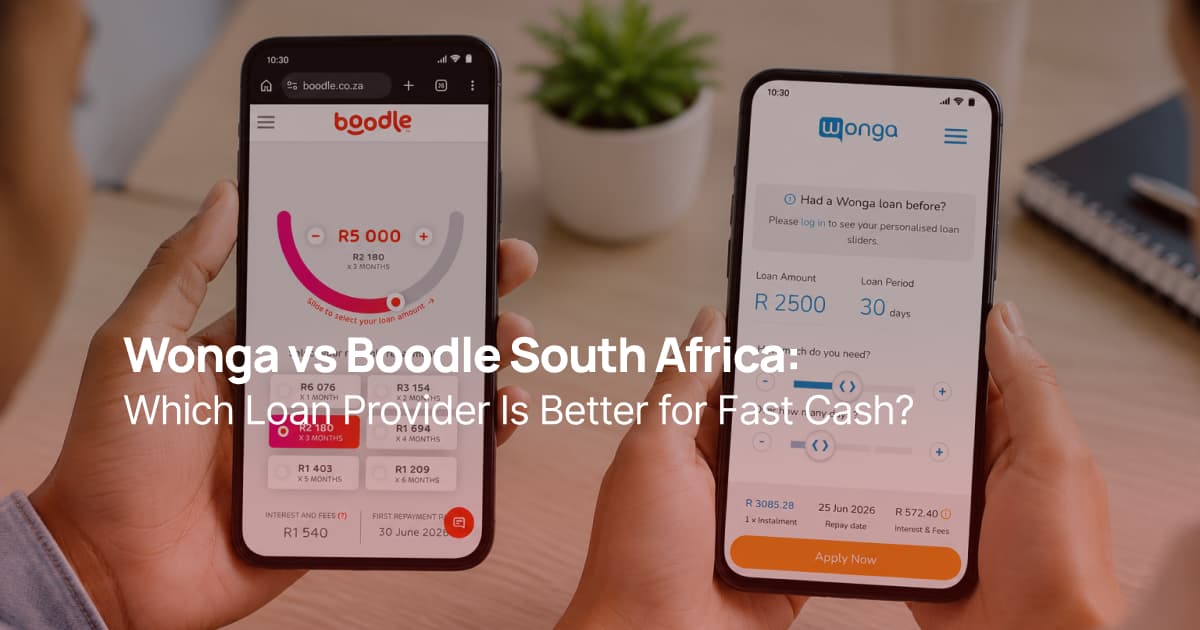
Two of the names that frequently appear in searches for payday loans and fast online cash loans are Wonga and Boodle. Both loan providers offer short-term lending solutions through digital applications, allowing consumers to apply online without visiting a branch. However, despite offering similar services, the two lenders differ in several important areas.
For example, Boodle is often associated with faster approvals and near-instant payouts, while Wonga may offer lower monthly interest rates for returning customers.
But speed isn’t always the same thing as how much you can borrow based on your salary in South Africa.
In this Wonga vs Boodle comparison, we’ll break down:
- loan amounts and repayment terms
- approval times and payout speed
- interest rates and total borrowing costs
- customer complaints and common issues
- and important risks borrowers should understand before taking a payday loan in South Africa
What Are Wonga and Boodle?
Wonga and Boodle are two established online micro-lenders operating within the regulatory framework of South Africa’s short-term credit market. Both platforms utilize automated fintech infrastructure to assess creditworthiness, bypassing the lengthy manual paperwork required by traditional retail banks. Both companies are registered with Micro Finance South Africa (MFSA) and the National Credit Regulator (NCR).
While both serve consumers requiring urgent capital before their next salary deposit, they diverge in their structural approach to risk, customer loyalty, and repayment timelines. Consequently, analyzing Wonga vs Boodle requires looking past the marketing to evaluate the exact fees, regulatory caps, and real-world delivery speeds of each platform.
What Is Wonga?
Wonga is a digital-first short-term lender that has operated in South Africa for over a decade. It operates via a sliding-scale interface where users select their desired capital and duration. Wonga’s structural model relies heavily on a dynamic risk profile system; first-time applicants face lower initial lending caps, but repeating borrowers unlock access to larger capital pools and lower relative rates through an escalating loyalty framework.
What Is Boodle?
Boodle is a localized online short-term credit provider also operating in South Africa. The platform’s primary focus is frictionless delivery speed, utilizing automated open-banking integrations to quickly cross-reference applicant data. Boodle targets consumers facing immediate, unexpected emergencies by prioritizing a highly automated rapid-quote system designed to give structural terms within minutes.
Wonga vs Boodle: Key Differences (2026)
| Feature | Boodle | Wonga |
|---|---|---|
| New Customer Max Loan | Up to R3,000 | Up to R5,000 |
| Existing Customer Max Loan | Up to R8,000 | Up to R8,000 |
| Repayment Term | 1 to 6 months | 6 days to 6 months |
| Max Interest Rate (NCA Cap) | 5% monthly (first loan) | 5% monthly (first loan) |
| Subsequent Loan Interest | 3% monthly | 3% monthly (or lower based on loyalty rating) |
| Monthly Service Fee | R60 + VAT (R69 total) | R60 + VAT (R69 total) |
| Best For | Instant approval and payout speed | Lower costs for verified returning users |
Which Loan Provider Is Faster?
When evaluating digital lenders, processing speed depends on two milestones: automated verification time and interbank clearance speed.
Boodle holds a distinct operational advantage regarding payout speed. Its automated screening software processes bank statement verification natively within the web application. If an applicant meets the automated credit requirements and electronically accepts the digital contract, Boodle’s platform initiates an instant payout mechanism that typically lands funds in the borrower’s account within 10 minutes, assuming standard banking infrastructure compatibility.
Wonga is entirely digital but generally operates with more conservative fraud and credit review guardrails. While applications are processed 24/7, manual verification anomalies or credit bureau synchronization delays can push Wonga’s funding timeline from a few hours to a full business day.
The Speed vs. Affordability Trade-Off: Borrowers should recognize that rapid, ten-minute funding mechanisms charge peak regulatory pricing to offset the provider’s heightened risk profile. Opting exclusively for the fastest approval platform often prevents consumers from shopping around for lower initiation fees or better loyalty rates elsewhere.
Which One Is Cheaper?
In South Africa, both Wonga and Boodle are legally governed by the National Credit Regulator (NCR) under the National Credit Act (NCA). This means neither platform can legally exceed the maximum prescribed interest rate caps for short-term credit transactions, which are currently defined as:
- 5% per month on the first loan within a calendar year.
- 3% per month on subsequent loans within that same year.
Both lenders also levy an initiation fee (R165 plus 10% of the loan value exceeding R1,000, capped at 15%) and a standard monthly service fee of R60 excluding VAT.
Despite identical maximum legal caps, Wonga is often the more cost-effective option for returning consumers. Wonga uses an internal credit tier system called a “Trust Rating”. As a borrower successfully repays loans on schedule, their internal rating increases, allowing Wonga to offer individualized interest rates below the maximum legal 3% subsequent cap.
Boodle structurally leans closer to standard short-term flat rates. While fully transparent with its fee configurations via the SmileDial tool, Boodle rarely discounts its baseline rates below the legally allowed margins for high-risk profiles, as its business model prioritizes processing speed over long-term customer relationship discounting.
Example Loan Comparison
The following breakdown details the total borrowing costs for a new customer taking out a standard R2,000 short-term loan for a duration of exactly one month (30 days).
| Cost Factor | Boodle (New Customer) | Wonga (New Customer) |
|---|---|---|
| Principal Amount | R2,000.00 | R2,000.00 |
| Initiation Fee (Incl. VAT) | R304.75 | R304.75 |
| Monthly Service Fee | R69.00 | R69.00 |
| Interest Rate Charges | R102.00 (Flat 5.1% calculated daily) | R100 (Standard 5%) |
| Credit Life Insurance | Calculated dynamically per profile | Calculated dynamically per profile |
| Estimated Total Repayable | ~R2,475.75 | ~R2,473.75 |
Disclaimer: These figures serve as statistical estimates based on baseline regulatory fee parameters. Actual total repayment figures will fluctuate dynamically depending on your personalized credit profile, your specific employer industry, exact repayment dates, and the specific cost of required credit life insurance policies.
Ultimately, total repayable costs matter far more than the stated monthly percentage rate alone. Because short-term interest accrues daily, repaying a loan early on either app will reduce the total cost of credit.
Customer Complaints & Common Issues
Short-term lending models naturally attract consumer friction due to the high-velocity nature of the transactions. An analysis of consumer forums, HelloPeter listings, and dispute indices reveals distinct, recurring operational complaints for both platforms.
1. Account Reconciliation & Delayed Updates
A frequent issue cited by borrowers involves a lag between making a manual payment and the platform’s internal dashboard updating the loan status. Users report cases where they settled a loan via electronic funds transfer (EFT), but automated debit orders still triggered on payday because the system failed to clear the account before the bank run.
2. Credit Bureau Clearance Bottlenecks
Once a payday loan is fully paid off, lenders are legally required to update credit bureaus like TransUnion and Experian within a specified timeframe. Both Wonga and Boodle face recurring consumer complaints regarding delays in removing “active loan” statuses from user profiles. This structural bottleneck can negatively impact a consumer’s credit profile if they are concurrently applying for long-term asset funding, like vehicle finance or a home loan.
3. Settlement Quote Discrepancies
Borrowers attempting to settle their account early to minimize daily interest accrual occasionally report difficulties obtaining a real-time, accurate early-settlement quote. Automated systems sometimes calculate the full monthly fee structure instead of pro-rating the daily interest accumulated up to that specific day.
Who Should Consider Boodle?
Boodle is best for people who need quick, small-amount cash and want a simple, fast, short-term loan.
You might want Boodle if:
- You-re in a true same-day emergency, like a car breakdown or urgent medical bill, and you need money quickly.
Boodle offers fast online approvals and pays out soon after approval, often within the same day if you qualify and get through the checks. - You only need money for a short period until your next payday, not a long-term loan.
For example, if you need R1,000-R3,000 to cover an urgent expense a few days before payday.
Boodle suits small-amount borrowers who want a local, online-friendly lender.
Who Should Consider Wonga?
Wonga is better for people who value trust, repeat use, and slightly longer repayment options over “instant” speed.
You might want Wonga if:
- You’re a returning or regular borrower who expects to need short-term cash from time to time.
Wonga builds a long-term relationship with you, and if you repay on time, your costs can go down over time because they see your history as less risky. - You’d rather split a bigger expense into monthly instalments instead of taking one big lump-sum hit.
Wonga offers formal short-term loans over several months (up to 6 months in some cases), so you can spread the cost and keep your payday less stressful.
The Hidden Risks of Payday Borrowing
While micro-loans offer short-term utility, they remain an exceptionally expensive form of credit. Borrowers must enter these agreements with a clear exit strategy to avoid long-term financial consequences.
- The Debt Cycle Trap: If you take home R15,000 and must repay R2,500 to a short-term lender on the 25th, your available salary for the next month immediately drops to R12,500. This structural deficit frequently forces consumers to take out another loan the following month, creating a compounding trap. In extreme debt-counseling cases, some over-indebted borrowers have been found allocating up to 70% of their net salary strictly to short-term fees.
- Impact on Primary Credit Health: Multiple payday loans on a credit report, even when paid on time, signal cash flow distress to primary banking algorithms, making it harder to qualify for prime-rate car finance or home bonds later.
To protect your financial health, read our guide on how to avoid loan scams in South Africa or browse our actionable breakdown on 10 ways to survive until payday in South Africa.
Alternatives to Wonga and Boodle
Before entering into a high-interest short-term credit agreement, consumers should evaluate alternative fintech and structural alternatives:
- Fasta: An innovative online micro-lending provider that integrates directly with e-commerce payment checkouts, offering structured installment financing options for specific retail and grocery needs.
- LendPlus: A fast-growing online micro-lender in South Africa that leverages automated data processing to offer short-term emergency cash loans from R500 to R4,000. They specialize in quick digital registrations and rapid, 15-minute fund transfers once an affordability check via secure digital bank statements is cleared.
- PrimeLoans: A newer addition to South Africa’s digital credit scene that processes applications purely through a mobile smartphone app. They focus on immediate-need loans up to R4,000 with strict adherence to National Credit Regulator (NCR) guidelines, offering automated approvals based on your South African ID and confirmed employment.
- Crediwise: Rather than acting as a direct micro-lender, this serves as an advanced digital loan aggregator and comparison engine. It allows consumers to enter their credit and affordability details once to pull personalized, side-by-side personal loan quotes from several leading South African providers without suffering multiple credit-score-damaging “hard inquiries”.
- Jabulani Money: Offers quick applications and rapid approvals, with approved loan funds typically deposited directly to consumers bank account on the same day or the following business day. For a deep dive into their operational structure, read our evaluation of the terms and conditions of Jabulani Money.
Always compare multiple lenders before borrowing. Do not let processing speed blind you to total long-term borrowing costs. Take 10 minutes to review the initialization documents, look closely at the early settlement fees, and confirm that your chosen credit provider displays a valid National Credit Regulator (NCR) registration number.