Black Friday South Africa 2026: How to Spot Real Deals and Avoid Overspending
Advertiser Disclosure: MoneyHello is an independent, advertising-supported comparison service. We may earn a referral fee if you click our links or use our matching tool to connect with a lender. This does not affect the content of our articles or the loan offers you receive.
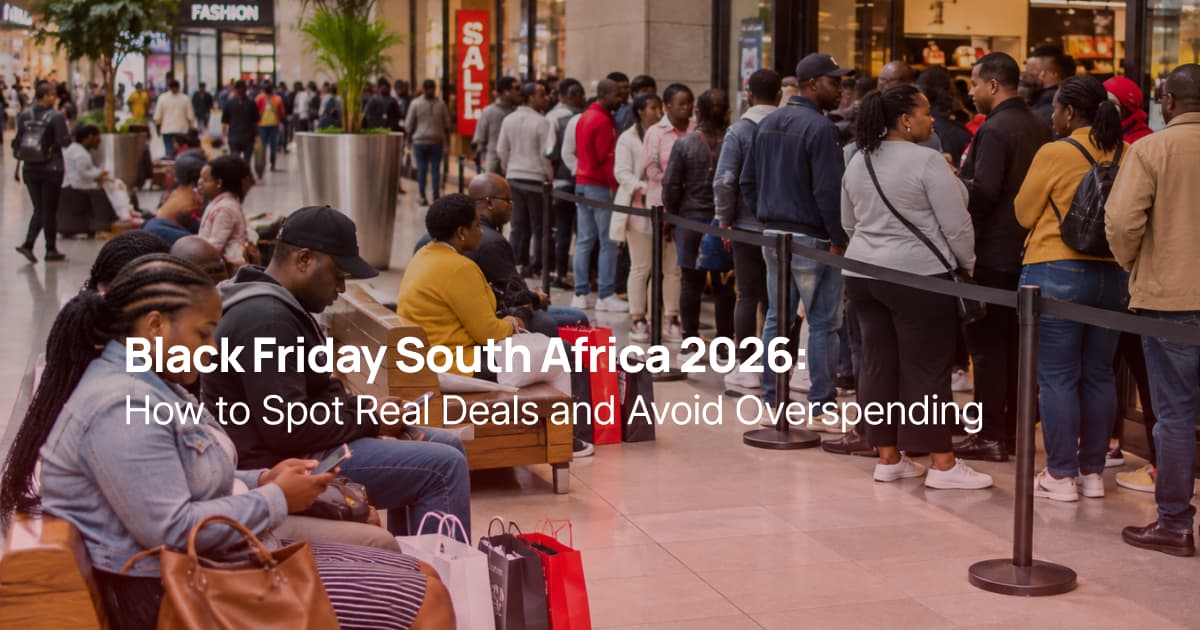
Black Friday is one of South Africa’s biggest shopping events, with retailers advertising discounts on everything from groceries and clothing to smartphones, appliances and furniture.
But a big discount doesn’t always mean a good deal.
A product advertised at 50% off might still cost more than it did a few weeks earlier. A buy-now-pay-later offer can make an expensive purchase seem affordable, while delivery fees and other charges can push the final price above your budget.
With Black Friday 2026 falling on Friday, 27 November, now is a good time to plan what you actually need, compare prices and decide how much you can comfortably spend.
This guide explains how to spot genuine Black Friday deals in South Africa, avoid common shopping traps and protect your December and January budgets.
When Is Black Friday 2026 in South Africa?
Black Friday 2026 falls on Friday, 27 November 2026.
Although Black Friday officially takes place on one day, many South African retailers run promotions throughout November. Some also offer Cyber Monday deals, which fall on 30 November 2026.
That means you don’t necessarily need to rush into buying something on the Friday itself.
The better approach is to research prices in advance and compare the final cost across several retailers.
1. Check Whether the Discount Is Real
One of the biggest mistakes shoppers make is trusting the percentage displayed on a sale banner.
Imagine you’ve been looking at a microwave.
| Price information | Amount |
|---|---|
| Price earlier in November | R1,299 |
| Advertised original price | R1,799 |
| Black Friday sale price | R1,199 |
| Advertised discount | 33% |
| Actual saving compared with the earlier price | R100 |
Illustrative example, not a verified retailer promotion.
The advertised discount looks impressive, but the saving compared with the earlier price is only R100, approximately 7.7%.
What to do: Check the price before Black Friday, compare the same product at different stores and look at the final checkout amount.
Don’t rely on the crossed-out price alone.
2. Make a Shopping List Before the Sales Start
Black Friday promotions are designed to attract attention. Without a plan, it’s easy to buy things you hadn’t considered purchasing.
Divide your shopping list into three categories:
- Essentials: Items you genuinely need, such as replacing a broken appliance or buying necessary school supplies.
- Planned purchases: Items you’ve been saving for and can afford.
- Nice-to-haves: Things you would enjoy but don’t need immediately.
Prioritise essentials and planned purchases. Leave nice-to-haves until you’ve checked your remaining budget.
A useful question is:
“Would I still buy this if it wasn’t on sale?”
If the answer is no, the discount may be creating the desire to buy rather than helping you save.
3. Set a Black Friday Budget You Can Actually Afford
Your shopping budget should come from money available after essential expenses, existing debt repayments and savings for upcoming commitments.
For many South African households, November and December can bring additional costs, including family gatherings, festive-season groceries, travel and January school expenses.
Example: A Black Friday Budget on a R12,000 Salary
Imagine you take home R12,000 per month.
| Monthly budget | Amount |
|---|---|
| Take-home salary | R12,000 |
| Rent and utilities | R3,500 |
| Groceries | R2,200 |
| Transport | R1,600 |
| Airtime and data | R350 |
| Other essentials and family contributions | R1,250 |
| Existing debt repayments | R800 |
| December and January savings | R1,000 |
| Available for shopping and other unplanned costs | R1,300 |
Illustrative budget for one household. Actual expenses vary by location, household size and financial commitments.
Having R1,300 left doesn’t mean you should spend the entire amount on Black Friday.
You might choose to limit your shopping to R500 and keep R800 available for unexpected expenses.
The important thing is to decide on your limit before seeing the promotions.
4. Compare the Total Price, Not Just the Sticker Price
A product’s advertised price isn’t always the amount you’ll actually pay.
Before placing an order, check:
- Delivery or collection charges
- Installation or assembly costs
- Warranty and return conditions
- Minimum-spend requirements for promotional discounts
- Any interest or fees associated with paying in instalments
For example, a washing machine advertised for R4,499 with R350 delivery costs R4,849 in total. Another retailer offering the same model for R4,699 with free delivery could be the better deal.
Compare identical model numbers, specifications and warranty coverage wherever possible.
5. Be Careful With Buy Now, Pay Later Offers
Buy now, pay later (BNPL) services allow shoppers to split certain purchases into instalments.
These arrangements can be convenient, but they can also encourage spending beyond your original budget.
Consider a R3,000 purchase split into four payments of R750.
The individual instalments may look manageable. However, if you’re already paying for other purchases, the combined repayments could put pressure on your next salary.
Before using a BNPL service, ask yourself:
- Can I afford every instalment on its due date?
- What happens if I miss a payment?
- Are there late fees or other charges?
- Will the repayments affect my December or January budget?
Some arrangements may be interest-free when paid on time, but terms vary by provider.
An affordable instalment is not necessarily an affordable purchase.
Before committing to instalments, make sure you understand how borrowing costs work. Our guide to personal loan interest rates in South Africa explains why the total repayment amount matters more than the monthly payment alone.
6. Watch Out for Black Friday Shopping Scams
Scammers can take advantage of busy shopping periods by creating fake websites, social media advertisements and messages offering unusually large discounts.
Warning signs include extremely low prices, suspicious website addresses, pressure to pay immediately and requests for sensitive banking information.
To shop more safely:
- Visit retailers through their official websites or apps.
- Check the website address carefully before paying.
- Avoid sharing your banking PIN, password or one-time password.
- Be cautious about unfamiliar sellers requesting direct bank transfers.
- Keep your order confirmation and proof of payment.
For further consumer guidance, visit the National Consumer Commission and the South African Banking Risk Information Centre.
Shopping scams aren’t the only financial risks to watch out for. If you’re considering borrowing to cover a purchase, read our guide on how to avoid loan scams in South Africa before sharing personal information with an unfamiliar provider.
7. Don’t Forget About January Expenses
Black Friday arrives just weeks before the festive season.
It’s tempting to focus on November discounts without thinking about what happens after December.
But January can bring its own financial pressure, particularly for households paying for school uniforms, stationery, transport and other back-to-school essentials.
Before buying something on Black Friday, consider whether the purchase could leave you short of money for these commitments.
If you already know you’ll need to replace school shoes or buy stationery in January, setting money aside now may be more valuable than buying another discounted gadget.
If your budget is already under pressure before the festive season, our guide to surviving until payday in South Africa offers practical ways to manage everyday expenses without relying on impulse purchases.
8. Should You Take Out a Loan for Black Friday Shopping?
Borrowing to purchase something simply because it’s discounted can be risky.
A sale price might save you money compared with the usual retail price, but interest and fees on a loan could reduce or eliminate that saving.
For example, imagine an appliance usually costs R4,000 and is advertised for R3,200.
The advertised saving is R800.
If you borrow to pay for it, the total amount you repay will depend on the lender’s interest rate, fees and repayment period. If those borrowing costs exceed R800, the purchase could ultimately cost more than the original price.
If you’re considering borrowing, it’s important to understand the consequences of missed repayments. Our guide explains what happens if you don’t pay a loan in South Africa.
This doesn’t mean borrowing is never appropriate. A necessary replacement appliance may be a different financial decision from an impulse purchase.
However, before taking a loan, you should compare the total amount repayable, not just the monthly instalment.
MoneyHello helps South African consumers compare loan options from participating lenders. MoneyHello is not a lender, and eligibility, costs and approval decisions depend on the individual lender.
If you’re considering borrowing for a necessary expense, you can compare available loan options on MoneyHello before deciding.
9. Know Your Consumer Rights
South African consumers have protections under the Consumer Protection Act, including rules relating to misleading marketing, product quality and certain returns.
However, not every unwanted purchase can automatically be returned for a refund. Your rights depend on the circumstances, including whether goods are defective, how they were purchased and the applicable legal provisions.
Before checking out, read the retailer’s return policy and keep your receipt.
For more information, see the Consumer Protection Act, 2008.
10. Use the 24-Hour Rule for Unplanned Purchases
A simple way to avoid impulse spending is to wait before buying something that wasn’t on your original shopping list.
If you see a discounted item you suddenly want, give yourself 24 hours to think about it, where practical.
During that time, ask:
- Do I genuinely need this?
- Have I compared prices elsewhere?
- Can I pay for it without borrowing or missing other commitments?
- Would I still want it tomorrow?
A genuine bargain is only useful if the purchase makes sense for your financial situation.
Black Friday 2026 in South Africa: Frequently Asked Questions
When is Black Friday 2026 in South Africa?
Black Friday takes place on Friday, 27 November 2026. Cyber Monday follows on Monday, 30 November. Some retailers have already launched early promotions, including Takealot’s weekly Black November deals.
How can I tell if a Black Friday deal is genuine?
Compare the sale price with the product’s earlier price, check the same model at other retailers and include delivery charges. You can use a South African price-comparison website such as PriceCheck to research offers and price histories.
Is Black Friday cheaper than Christmas sales?
Not necessarily. Prices vary by product, retailer and stock availability. Compare the actual price rather than assuming one shopping event always offers better discounts.
Can I return a Black Friday purchase?
Black Friday purchases are subject to applicable South African consumer laws. Some online purchases qualify for a cooling-off period, subject to legal exceptions, while defective products may carry additional protections. Check the purchase circumstances and the retailer’s policies.
Is it a good idea to use credit for Black Friday?
Using credit can increase the total cost of a purchase through interest and fees. Before borrowing, calculate the full repayment amount and check whether the repayments fit alongside your essential monthly expenses.
What should I buy on Black Friday in South Africa?
Prioritise products you already planned to purchase, have researched and can comfortably afford. Groceries with a long shelf life, necessary household appliances and planned school supplies may be worth comparing, provided the discount is genuine.
Final Thoughts: A Good Deal Shouldn’t Create Financial Stress
Black Friday 2026 can be an opportunity to save on purchases you genuinely need. But the biggest advertised discount isn’t always the best deal.
Compare prices, check the full cost, read the terms and keep December and January commitments in mind.
The best Black Friday purchase is one that saves you money without putting your budget under pressure.